
How?
“Our strategy should be not only to confront empire, but to lay siege to it. To deprive it of oxygen. To shame it. To mock it. With our art, our music, our literature, our stubbornness, our joy.."-Roy

I continue to be unsure how often to write to you, and how to write about devotion. How to practice devotion—to my writing and art, to my relationships, to imagining and co-creating an otherwise beyond the war machine—when I catch myself humming that inculcated anthem: More, better, faster? Living in the Global North, I can walk for miles looking without seeing. Worrying instead over my debts and health, consumed by myriad illusions of urgency. There is the very real urgency of rising fascism across the globe, material need, and refusing the violence that defines living under empire. How to refuse the ways this country exports violence and death in the name of “safety”?
That relentless bombardment continues with U.S. tax dollars, in the effort to decimate an entire people and seize land—a familiar story, upgraded with the latest surveillance technology and chemical warfare—while accelerating climate change for all, our cities increasingly militarized, people punished for calling a genocide a genocide, for attempting to refuse mass death, while administrations abandon working people here year after year—amidst a slew of entangled issues not limited to the dismantling of higher education, defunding of the arts, exorbitant costs of living, and the manufacturing of consent by our so-called free press, that cornerstone of our mythical democracy—is a war also on our very minds, critical thinking abilities, and emotional capacities.
The question of how to refuse all of this cannot be answered alone in a single lifetime, and cannot stay on the page. I think it needs wrestling with through action, however small, ongoingly, by each of us in our particular webs of care. Forgive me if it sounds as though I am writing to you from atop a greasy soapbox, thinking myself scrubbed nice and clean. I write from within the mess and ache of all this, while trying to make this life of writing and art—of writing my books and supporting others in their making—that I have felt called to since childhood, a life that feels increasingly ridiculous to dream toward in my particular material circumstance, in these expensive, exhausting times. But it is a time to draw strength from social movements, autonomous zones, and acts of care worldwide, both ongoing and past. I feel the urgent need to strengthen my knowledge of the undersides of history, to gather fuel and grow my emotional capacities for struggles now and ahead. I know too little, but I recognize devotion, conviction, love enacted when watching people around the world board flotillas setting sail for Palestine. There are countless gorgeous acts of refusal and imagination near and far, which I am trying to better attend to, to really see.
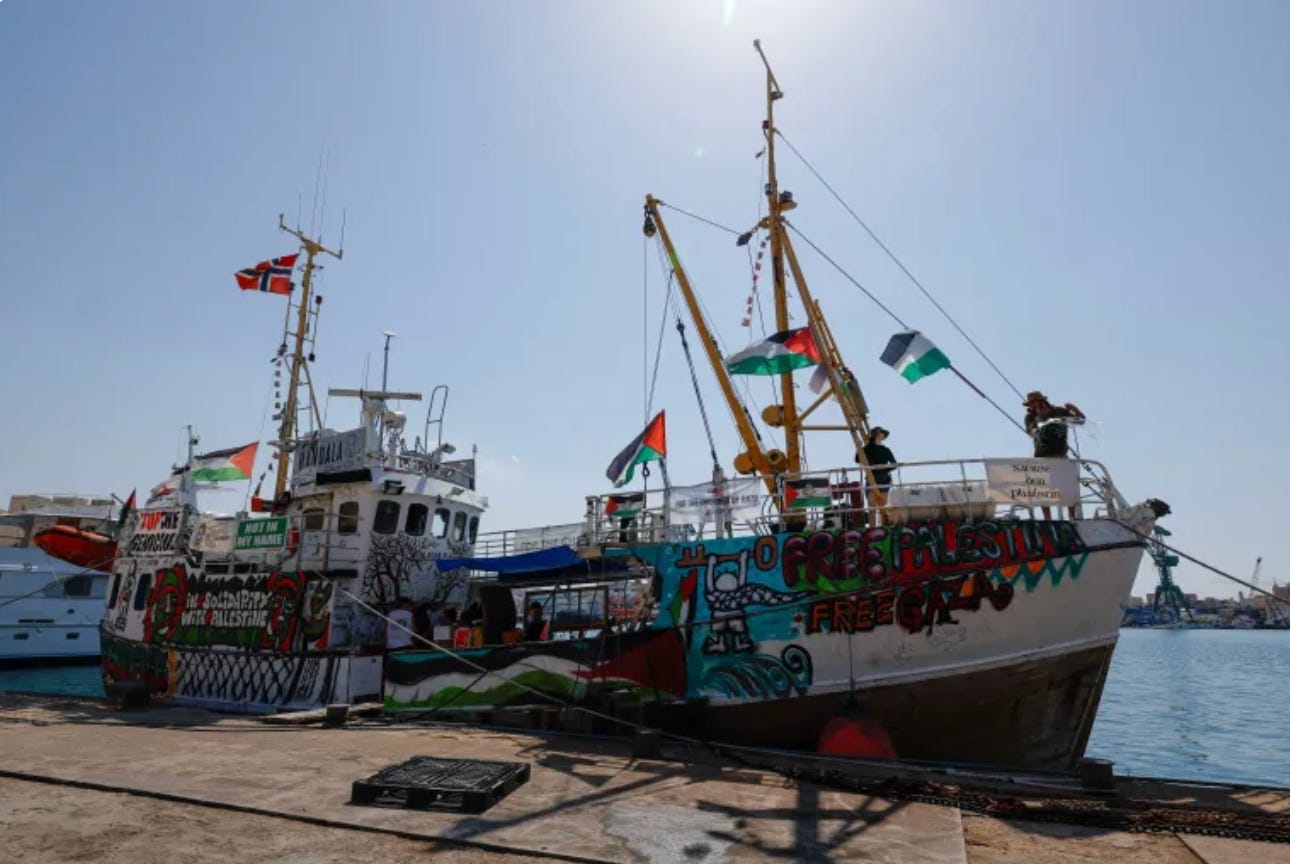
I have been reading, finally, Arundhati Roy’s gorgeous novel The God of Small Things and attending to the author’s way in the world—listening to interviews with her and noting the lush precision of her language within and outside of her fiction. I am moved by her oft-quoted lines: “Another world is not only possible, she is on her way. On a quiet day, I can hear her breathing.” The fuller passage reads:
“Our strategy should be not only to confront empire, but to lay siege to it. To deprive it of oxygen. To shame it. To mock it. With our art, our music, our literature, our stubbornness, our joy, our brilliance, our sheer relentlessness—and our ability to tell our own stories. Stories that are different from the ones we’re being brainwashed to believe.
The corporate revolution will collapse if we refuse to buy what they are selling – their ideas, their version of history, their wars, their weapons, their notion of inevitability.
Remember this: We be many and they be few. They need us more than we need them.
Another world is not only possible, she is on her way. On a quiet day, I can hear her breathing.” —Arundhati Roy, War Talk
I am writing new work, poetry and prose(!) , and learning how to be—how I want to be—a writer in the world. In a few weeks, it’ll be the six month mark of my first book out. That people continue to read We Contain Landscapes with such care and thoughtfulness jolts me into gratitude. Among gratitudes: a recent review in Poetry Northwest by Miriam Milena; Livia Meneghin’s review in Colorado Review; this conversation with Swati Sudarsan in The Adroit Journal, excerpted below.

If you’d like to work together, I am freelance editing & teaching, and my books are open! I have upcoming virtual generative classes, including Devotion: A Generative Workshop, on Saturday, September 13th, 11am-12.30pm CT and Lake Effect: A Generative Workshop on Sunday, September 21st, 11am-12.30pm CT, $40-60 sliding scale. More info on course offerings below, and more TBA.
I offer individualized sessions via Zoom and written feedback. I love working with people on their book projects at any stage, be it ideation/generating work, developmental editing and deep revision, or copyediting. While I specialize in poetry, I also edit CNF/essays, fiction, academic work, and more. In addition to helping book projects come to fruition, I also provide feedback on shorter projects. I have a background in dance-based performance and love to support the development of performance and hybrid works.
💌 Get in touch via email or the contact form on my website with your needs/hopes/questions.
🌀 Reach out about coming to your city with We Contain Landscapes! I am still doing class visits and readings. Next up, I’ll be in Houston, TX with the Gulf Coast Reading Series at Lawndale Art Center on Friday, September 27th, 7pm CT.
Upcoming Course Offerings:


If you’re seeking more writing workshops, check out Workshop4Gaza.
Stay hydrated <3,
Patrycja